In today’s hyper-competitive business landscape, digital transformation is no longer a luxury; it is an absolute necessity. As we navigate through 2026, companies across North America are realizing that generic, one-size-fits-all software solutions are no longer sufficient to drive meaningful growth, streamline complex operations, or deliver exceptional customer experiences. Enter customized application development—the strategic cornerstone for enterprises aiming to future-proof their operations and gain a definitive competitive edge.
Whether you are a burgeoning startup or an established enterprise, understanding the nuances of tailor-made software is critical. This comprehensive guide will explore what customized application development entails, why it outperforms off-the-shelf alternatives, the tangible benefits it brings to various industries, and how partnering with a trusted provider like HiSoft Corporation can turn your unique business vision into reality.
What is Customized Application Development?
Customized application development is the process of designing, building, and deploying software solutions that are specifically tailored to meet the unique requirements, workflows, and goals of a particular business. Unlike commercial off-the-shelf (COTS) software, which is built for a broad, generalized audience, custom applications are crafted from the ground up to address your organization’s specific pain points. Think of it like the difference between buying a suit off the rack and having one tailored by a master tailor. The off-the-rack suit might fit "well enough," but it will never contour perfectly to your exact measurements, accommodate your unique posture, or reflect your personal style. Similarly, a customized application is engineered to fit your business processes like a glove, eliminating unnecessary features while amplifying the functionalities that matter most to your operations.
This bespoke approach encompasses everything from enterprise resource planning (ERP) systems and customer relationship management (CRM) platforms to specialized mobile applications and internal workflow automation tools. The end goal is always the same: to create a scalable, secure, and highly efficient digital asset that works exclusively for you.
The Hidden Costs of Off-the-Shelf Software
Many businesses initially gravitate toward off-the-shelf software because of its seemingly lower upfront cost and immediate availability. However, this short-term savings often masks a variety of hidden, long-term expenses that can severely impact your bottom line.
1. Forced Workflow Adaptation Generic software dictates how you should work, rather than adapting to how you already work efficiently. This forces employees to alter proven, productive workflows to accommodate the software’s limitations, leading to frustration, decreased morale, and a drop in overall productivity.
- Escalating Licensing and Subscription Fees
While the initial purchase price might be low, SaaS (Software as a Service) models often charge per user, per month. As your company grows, these recurring fees compound rapidly. Furthermore, you are often forced to pay for premium tiers just to unlock basic features that a custom solution would include natively.
- Lack of Scalability
Off-the-shelf software is built to serve the average user. When your business experiences rapid growth or pivots its operational model, generic software often buckles under the pressure. Upgrading to a more robust enterprise version can be prohibitively expensive, or worse, technically impossible without a complete system migration.
- Integration Nightmares
Modern businesses rely on a tech stack comprising dozens of interconnected tools. Generic software frequently lacks native, seamless integration with your existing legacy systems, third-party APIs, or specialized databases. This results in data silos, manual data entry, and a higher risk of human error.
- Security Vulnerabilities
Because popular off-the-shelf software is used by millions of organizations worldwide, it is a prime target for cyberattacks. Hackers actively scan for known vulnerabilities in widely used platforms. A custom application, with its unique architecture and proprietary code, inherently presents a much smaller, less predictable attack surface.
Key Benefits of Tailor-Made Software Solutions
Investing in customized application development is an investment in your company’s future. The return on investment (ROI) manifests in several powerful ways:
Unmatched Scalability and Flexibility
A custom application is built with your future growth in mind. Whether you need to add new user modules, integrate emerging technologies like artificial intelligence, or expand into new geographic markets, a tailor-made solution can be scaled and modified incrementally without disrupting your core operations.
Enhanced Security and Regulatory Compliance
Industries such as healthcare, finance, and legal services are bound by strict regulatory frameworks (e.g., HIPAA, GDPR, SOC 2). Custom software can be engineered with compliance as a foundational pillar, incorporating role-based access controls, end-to-end encryption, and automated audit trails that generic software simply cannot guarantee.
Seamless Ecosystem Integration
A bespoke application is designed to communicate flawlessly with your existing infrastructure. Whether it is syncing with your current CRM, pulling data from your legacy database, or connecting to third-party payment gateways, custom development ensures a unified, frictionless technological ecosystem.
Superior User Experience (UX)
Because the software is built specifically fo r your team or your customers, the user interface (UI) can be optimized for maximum intuitiveness. Reduced learning curves mean faster onboarding for employees and higher satisfaction and retention rates for customers.
Long-Term Cost Efficiency
While the initial development cost of a custom application is higher than buying a generic license, the total cost of ownership (TCO) over a 5- to 10-year period is often significantly lower. You eliminate recurring per-user licensing fees, reduce the need for costly workarounds, and minimize downtime caused by software mismatches.
Industries That Benefit Most from Custom Applications
While virtually any business can benefit from tailored software, certain industries experience transformative results due to their highly specialized operational demands.
Healthcare and Life Sciences
Healthcare providers require robust systems for electronic health records (EHR), telemedicine platforms, and patient scheduling. Custom applications ensure strict HIPAA compliance while streamlining administrative tasks, allowing medical professionals to focus on patient care rather than paperwork.
Finance and FinTech
Financial institutions handle highly sensitive data and complex transactions. Custom-built applications enable advanced fraud detection algorithms, personalized banking experiences, and secure, real-time transaction processing that off-the-shelf banking software cannot adequately support. Retail and E-Commerce
In the retail sector, customer experience is everything. Custom e-commerce platforms can offer hyper-personalized product recommendations, unique loyalty programs, and seamless omnichannel inventory management that directly drive sales and customer retention. Logistics and Supply Chain
Global supply chains demand real-time visibility. Custom logistics applications can integrate GPS tracking, predictive analytics for route optimization, and automated warehouse management systems, reducing fuel costs and delivery times significantly. Manufacturing
Manufacturers benefit from custom IoT (Internet of Things) dashboards that monitor equipment health in real time, predict maintenance needs before a breakdown occurs, and optimize production schedules based on live data feeds.
The HiSoft Corporation Approach to Custom Application Development
When it comes to executing a successful digital transformation, the partner you choose is just as important as the technology itself. HiSoft Corporation stands out as a premier software development and technology solutions provider, uniquely positioned to serve the dynamic needs of the North American market.
Headquartered in Montreal, Quebec, Canada, with dedicated support channels and a strong presence in the USA, HiSoft Corporation has built a reputation for excellence .
. Their philosophy is simple yet powerful: With 11+ products and end-to-end support, we turn your vision into real results for companies across North America. . Here is what sets the HiSoft Corporation customized application development service apart:
Deep Discovery Phase: HiSoft does not just write code; they act as strategic consultants. They take the time to understand your business model, interview stakeholders, and map out your exact requirements before a single line of code is written.
Agile Methodology: Utilizing iterative development cycles, HiSoft ensures that you are involved at every stage. You receive regular updates, prototype reviews, and the flexibility to pivot features as market conditions change.
Future-Proof Architecture: Their engineering teams build applications using modern, cloud-native architectures that guarantee high availability, rapid performance, and effortless scalability.
End-to-End Support: The relationship does not end at deployment. HiSoft provides comprehensive post-launch maintenance, security patching, and continuous improvement support to ensure your application evolves alongside your business. . Step-by-Step Guide to Building a Custom Application
If you are considering embarking on a custom software journey, understanding the lifecycle of development will help you set realistic expectations and ensure a smooth process.
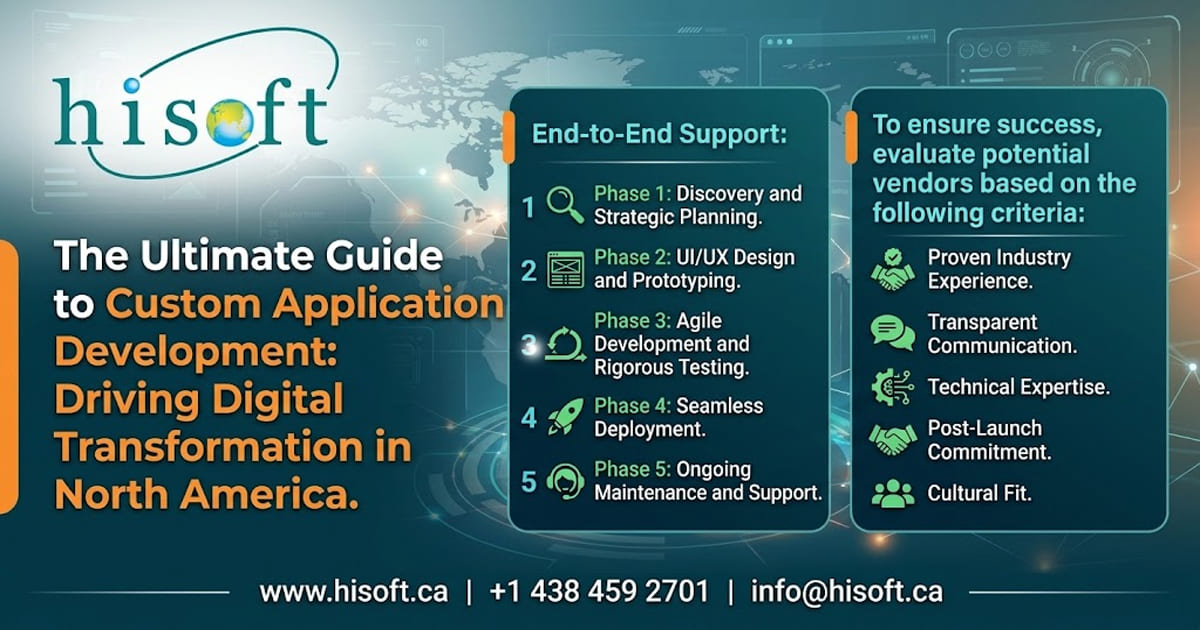
Phase 1: Discovery and Strategic Planning
This is the most critical phase. Your development partner will conduct workshops to define the project scope, identify core functionalities, establish a realistic budget, and create a detailed project roadmap. Deliverables typically include a Software Requirements Specification (SRS) document. Phase 2: UI/UX Design and Prototyping
Before development begins, designers create wireframes and interactive prototypes. This allows you to visualize the application’s look and feel, navigate the user journey, and provide feedback. Adjustments are made here to ensure the final product is highly intuitive.
Phase 3: Agile Development and Rigorous Testing
Developers begin coding the application in iterative "sprints." Simultaneously, quality assurance (QA) engineers conduct rigorous testing, including unit testing, integration testing, and user acceptance testing (UAT). This ensures the software is bug-free, secure, and performs optimally under various load conditions.
Phase 4: Seamless Deployment
Once the application passes all testing phases, it is deployed to the production environment. This phase includes data migration from legacy systems, server configuration, and final security audits to ensure a smooth transition with zero disruption to your daily operations.
Phase 5: Ongoing Maintenance and Support
Software is a living entity. Post-launch, your development partner will monitor system performance, release regular updates, patch any emerging security vulnerabilities, and add new features as your business grows. This is where HiSoft Corporation’s commitment to end-to-end support truly shines . How to Choose the Right Custom Software Development Partner
Selecting the wrong development partner can lead to missed deadlines, budget overruns, and a subpar product. To ensure success, evaluate potential vendors based on the following criteria:
Proven Industry Experience: Look for a company with a robust portfolio of successful projects in your specific industry. Ask for case studies and client testimonials.
Transparent Communication: Your partner should communicate clearly, provide regular progress reports, and be responsive to your questions. Avoid companies that use excessive jargon or obscure the development process.
Technical Expertise: Ensure the company employs certified developers proficient in modern programming languages, frameworks, and cloud infrastructure relevant to your project.
Post-Launch Commitment: A reliable partner will offer clear, structured maintenance and support agreements. Avoid agencies that disappear once the final invoice is paid.
Cultural Fit: You will be working closely with this team for months or even years. Choose a company whose values, work ethic, and vision align with your own.
HiSoft Corporation exemplifies these qualities, offering a blend of technical mastery, transparent processes, and a client-centric approach that has earned them trust across North America www.facebook.com . Future Trends in Custom Application Development
To truly future-proof your business, your custom application should be designed with an eye toward emerging technological trends. As we move further into 2026, several key trends are shaping the landscape of bespoke software:
- Artificial Intelligence and Machine Learning Integration
AI is no longer a futuristic concept; it is a present-day necessity. Custom applications are increasingly embedding machine learning models to automate routine tasks, provide predictive analytics, and deliver hyper-personalized user experiences through intelligent chatbots and recommendation engines.
- Cloud-Native and Serverless Architectures
Building applications specifically for the cloud ensures maximum scalability and resilience. Serverless computing allows businesses to run code without managing underlying infrastructure, reducing operational overhead and allowing developers to focus purely on business logic.
- Advanced Cybersecurity Measures
With cyber threats becoming more sophisticated, custom applications are now being built with "security by design" principles. This includes zero-trust architecture, biometric authentication, and automated threat detection powered by AI.
- Low-Code/No-Code Hybrid Models
While complex enterprise applications still require expert coding, development teams are increasingly utilizing low-code platforms for rapid prototyping and building internal administrative tools. This hybrid approach accelerates time-to-market without sacrificing the robustness of the final product. Conclusion: Take the Next Step Toward Digital Excellence
In an era where digital capability dictates market leadership, relying on outdated or generic software is a risk your business cannot afford. Customized application development offers a clear, proven pathway to streamline operations, enhance security, and deliver unparalleled value to your customers. However, the success of your custom software hinges entirely on the expertise of your development partner. You need a team that understands not just code, but business strategy. A team that offers more than just development—a team that provides end-to-end support and is dedicated to turning your unique vision into tangible, measurable results.
HiSoft Corporation is that partner. With a strong footprint in Montreal and the USA, a portfolio of 11+ innovative products, and a relentless commitment to client success, HiSoft is uniquely equipped to guide your enterprise through its digital transformation journey. . Do not let inefficient software hold your business back. Embrace the power of tailor-made technology.
Ready to transform your business operations? Contact HiSoft Corporation today to schedule a free, no-obligation discovery consultation. Let us build the customized application your business deserves, and together, we will turn your vision into reality.

HiSoft Corporation builds enterprise software — from SharePlus and digital AGMs to fully custom applications — for businesses across Canada, the USA and beyond.